Your USP Is An Asset

Why the businesses and people who win the contract are rarely the most qualified ones in the room
Every tender, every pitch deck, every capability statement in this country reads the same. Same buzzwords. Same case studies dressed up in different logos. Same promise to be "solutions focused" and "client centric." If you have ever wondered why some businesses keep winning the contract while others with the same qualifications go quiet, it is rarely about who was most capable. It is about who was easiest to remember, and who made it easiest to say yes.
That is what a USP is. Not a slogan on your website. Your USP is the honest answer to the question every client, funder, or employer is silently asking:
why you, and not the business next door.
We built Zeducation from a single workshop provider into a business running government contracts, commercial partnerships with the likes of Fulton Hogan and Spark, and a creative studio on the side. None of that happened because we were the cheapest or the most qualified on paper. It happened because we knew what made us different, and we treated that difference like an asset, not a nice to have.
Your USP sits where three markets meet
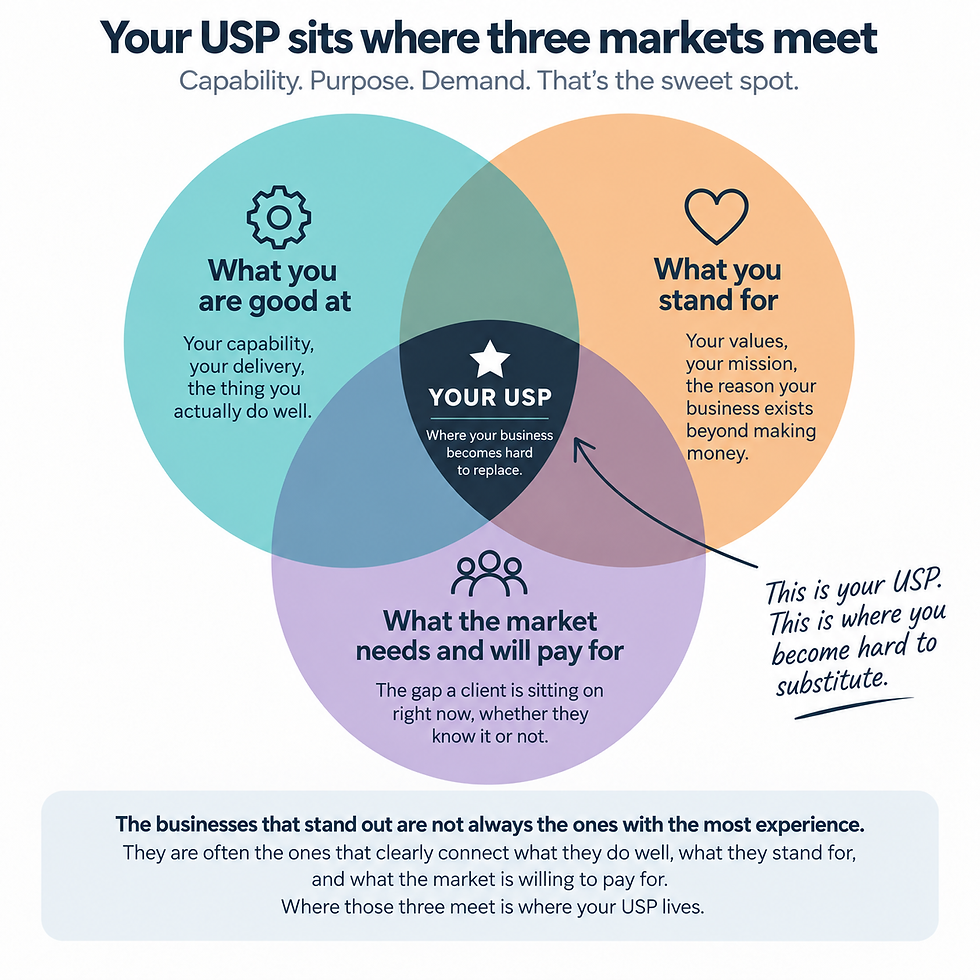
Think of it as three circles. One is what you are good at (your capability, your delivery, the thing you actually do well). One is what you stand for (your values, your mission, the reason your business exists beyond making money). One is what the market needs and will pay for (the gap a client is sitting on right now, whether they know it or not). Where all three overlap is where you become impossible to substitute.
The Design Factory sits exactly in that overlap. Our design and content capability, our commitment to telling authentic Pacific stories, and a real gap in the market for content that is not just localised branding on an American template. That is not a lucky accident. That is the model doing its job.
Your origin story is your competitive moat
A rough stone is not disqualified from becoming a diamond. The pressure is what makes it valuable.
If your business started from struggle, from being underestimated, from growing up without the networks other founders had handed to them, do not soften that in your pitch. That is not the weak point in your capability statement. That is your moat, because it cannot be copied, outsourced, or undercut on price. A competitor can match your pricing. They cannot match your story.
Zeducation's story starts with my parents, not with a business plan. I struggled with literacy at school. I got knocked back by universities more than once. None of that disqualified me. It became the reason clients trust us with communities other providers cannot reach. Your origin story is not a footnote in your marketing. For a lot of businesses, it is the actual reason someone signs.
If you do not know your USP yet, treat it like product testing
This is where most business owners get stuck, so it is worth slowing down here.
Finding your USP works the same way finding product market fit works. You do not know what sticks until you put something in front of real people and watch what they respond to. Nobody discovers their edge by staying in the planning phase.
So pitch more than one offer. Talk to more than one type of client. Ask for feedback, even the feedback that stings, and treat every no as data instead of rejection. Collect that feedback the way you would track any other business metric, because it becomes your mirror. It reflects back the thing you are actually known for, which is often not the thing you assumed you were selling.
You will not find your USP in a strategy session. You will find it in the market, through reps, adjustments, and more reps.
The Framework: U.S.P.

To make this something you can actually run your business by, here is how I break it down.
U = Upskilling
No business asset appreciates if you stop maintaining it, and that includes you. A blade left in the drawer goes blunt. The one that keeps getting used and sharpened stays useful. Keep reinvesting in your own capability the same way you would reinvest in equipment or systems.
S = Story
Your origin story is not soft marketing. It is the one line item on your capability statement a competitor cannot quote a lower price against, because they do not have it. Lead with it.
P = Proof
You can claim anything in a pitch, but a claim without proof is just a rumour about your business. Testimonials, case studies, data, results, that is what turns the rumour into a reputation. Positioning is the ongoing job of collecting that proof before you need it, not scrambling for it when a tender lands. When we point to eighteen people placed into work in a single week through Project Moana, that is not a boast in a proposal. That is proof doing the selling for us.
Nobody funds an idea. They fund proof.
For years I pitched what our programmes could look like for clients. Nothing moved. Then we actually delivered the programmes, captured the data, and collected the testimonials. Everything got a little easier after that.
Stop overworking the pitch. Work on the proof instead. Go get one piece of evidence you can point to. Evidence outperforms words every time.

Where this leaves you
Your USP is not something you brand once and leave on a slide. Like any asset, it compounds or it depreciates depending on whether you keep investing in it. You upskill, your story picks up new chapters, your proof stacks up, and your USP gets sharper with every cycle, the same way personal brand, pitch, positioning, and profit feed back into each other rather than running once and stopping.
But you have to go looking for it deliberately. Because if you do not know what makes your business different, the market will decide for you, usually by putting you in a line-up next to everyone else and comparing you on price.
Ask yourself: what is one capability, one value, and one piece of proof you could put in front of a client tomorrow that shows both? If you cannot answer that yet, that is not a failure. That is where the work starts.
Need help capturing your own proof, on camera, in a way that actually converts? Reach out about business coaching or content media support for your team.

Comments